Building an AI Auditor with Gemini CLI: Spec-Driven Development in Action
A deep dive into the GlobalAudit AI workshop, exploring how to use the Gemini CLI to orchestrate a serverless, multimodal compliance application purely through Markdown specifications.

GlobalAudit AI is an enterprise-grade multimodal application that automates corporate document auditing. Using Gemini 3.1 Pro, the system “reads” invoices, extracts structured data, and evaluates compliance against corporate policies—all within a secure, stateless Google Cloud environment.
But the most fascinating part of this workshop isn’t just what the application does; it’s how it’s built.
In this workshop, we move away from traditional line-by-line coding and embrace a new paradigm: Spec-Driven Development with the Gemini CLI.
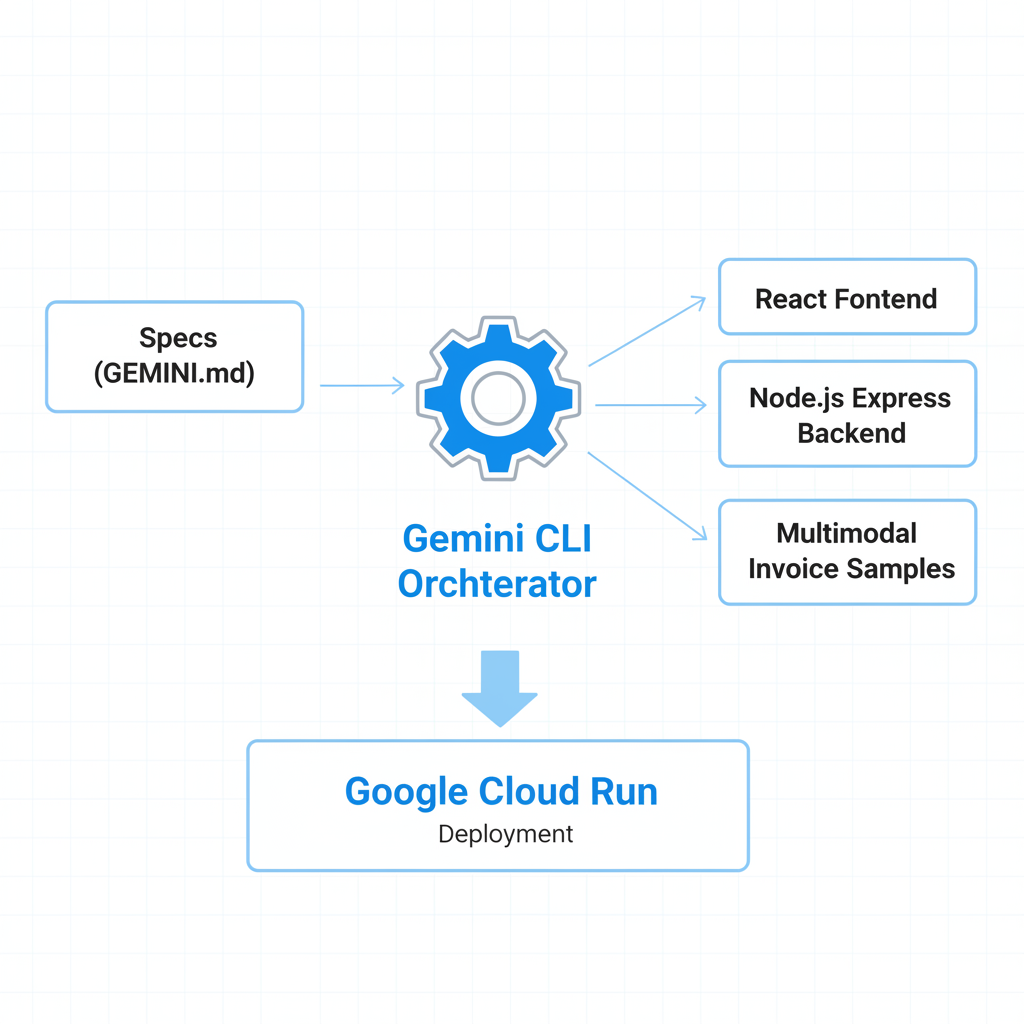 A high-level view of the Gemini CLI orchestration workflow.
📚 Resources & Links
- GlobalAudit AI GitHub Repository
- System Architecture Deep-Dive
- Backend Implementation Details
- Frontend Implementation Details
- Testing Strategy Overview
- Deployment & DevOps Guide
🧠 The Paradigm Shift: Coding by Specification
When using the @google/gemini-cli in an agentic workflow, the developer’s role shifts from a “code writer” to a “system architect.” Instead of writing Express routes or React hooks manually, you write highly structured Markdown documents that serve as the brain and the orchestrator for the AI.
In the GlobalAudit AI project, this is handled by two critical files:
GEMINI.md(The System Context): This file defines the persona, the security boundaries, and the technical constraints. It tells the AI:- Constraint 1: “All file handling must be stateless. Use
@google/genaifor enterprise-grade access.” - Constraint 2: “Implement an
fs.unlinkSync(path)call within afinallyblock to delete uploaded files immediately after model inference.” - Constraint 3: “Do NOT use
.envfiles. Rely exclusively on system environment variables.”
- Constraint 1: “All file handling must be stateless. Use
INIT-WORKSHOP.md(The Runbook): This file contains the step-by-step instructions (Tasks 1 through 7) that the Gemini CLI will execute. It maps the high-level prompts defined inGEMINI.mdto specific file paths and commands.
By treating these Markdown files as source code, the Gemini CLI acts as a highly capable sub-agent that autonomously scaffolds the entire project, ensuring all generated code strictly adheres to the defined architectural constraints.
🔍 What is GlobalAudit AI?
At its core, GlobalAudit AI is a compliance engine deployed on Google Cloud Run.
- Frontend: A zero-build React 18 SPA styled with Tailwind CSS, served directly from
public/index.html. It provides a clean, corporate dashboard for uploading invoices. - Backend: A lightweight Node.js Express server (
index.js). - The Intelligence: Instead of complex OCR pipelines and brittle Regex, the backend passes the uploaded image and a carefully crafted prompt directly to the Gemini 3.1 Pro Preview model.
The Prompt Logic: The model is instructed to extract the Vendor, Date, Amount, and TaxID (treating “VAT ID”, “TIN”, etc., as equivalents). It evaluates two primary compliance rules:
- Compliance Risk: Is the
TaxIDmissing, or is it just a placeholder like “[Insert VAT ID]”? If so, flag it. - Manual Review: Is the invoice amount greater than
$5,000? If so, flag it for human oversight.
🛠️ The Workshop Breakdown: Orchestrating the Build
Using the Gemini CLI, the entire application is brought to life through a sequence of automated tasks:
1. Generating the Application Logic
The CLI reads the INIT-WORKSHOP.md specs and generates the index.js (backend), the index.html (frontend), and the package.json. It applies the strict stateless /tmp file handling rules dictated in the specs.
2. Synthesizing Multimodal Test Data
You can’t test an AI invoice auditor without invoices. Using the nanobanana MCP (Model Context Protocol) server integrated with the Gemini CLI, the agent dynamically generates six highly-specific sample invoices:
- 3 Compliant (OK) Invoices: Including standard receipts, software subscriptions with alphanumeric VAT IDs, and professional consulting invoices.
- 3 Non-Compliant (NOT OK) Invoices: Including high-value invoices (triggering Manual Review) and messy handwritten receipts missing a Tax ID (triggering Compliance Risk).
3. Automated Verification & Testing
A truly agentic workflow must verify its own work. The CLI is instructed to act as a “QA Automation Engineer” to generate two test suites using Jest and Supertest:
tests/unit.test.js: Mocks the@google/genaiSDK to validate the backend’s routing and risk evaluation logic rapidly.tests/e2e.test.js: Spawns the server locally, uploads the 6 dynamically generated sample images, and asserts that the actual AI model’s responses match the expected compliance flags.
4. DevOps & Cloud Run Deployment
Finally, the CLI generates the production-ready Dockerfile (optimized for Node 20-slim and /tmp permissions) and the deploy.sh script required to push the stateless container to Google Cloud Run.
🚀 Conclusion
The GlobalAudit AI workshop is a masterclass in the future of software engineering. By mastering Spec-Driven Development with the gemini-cli, developers can focus on architecture, constraints, and business logic, while the AI agent handles the heavy lifting of implementation, data generation, and testing.
You aren’t just writing code anymore; you are managing a digital development team.