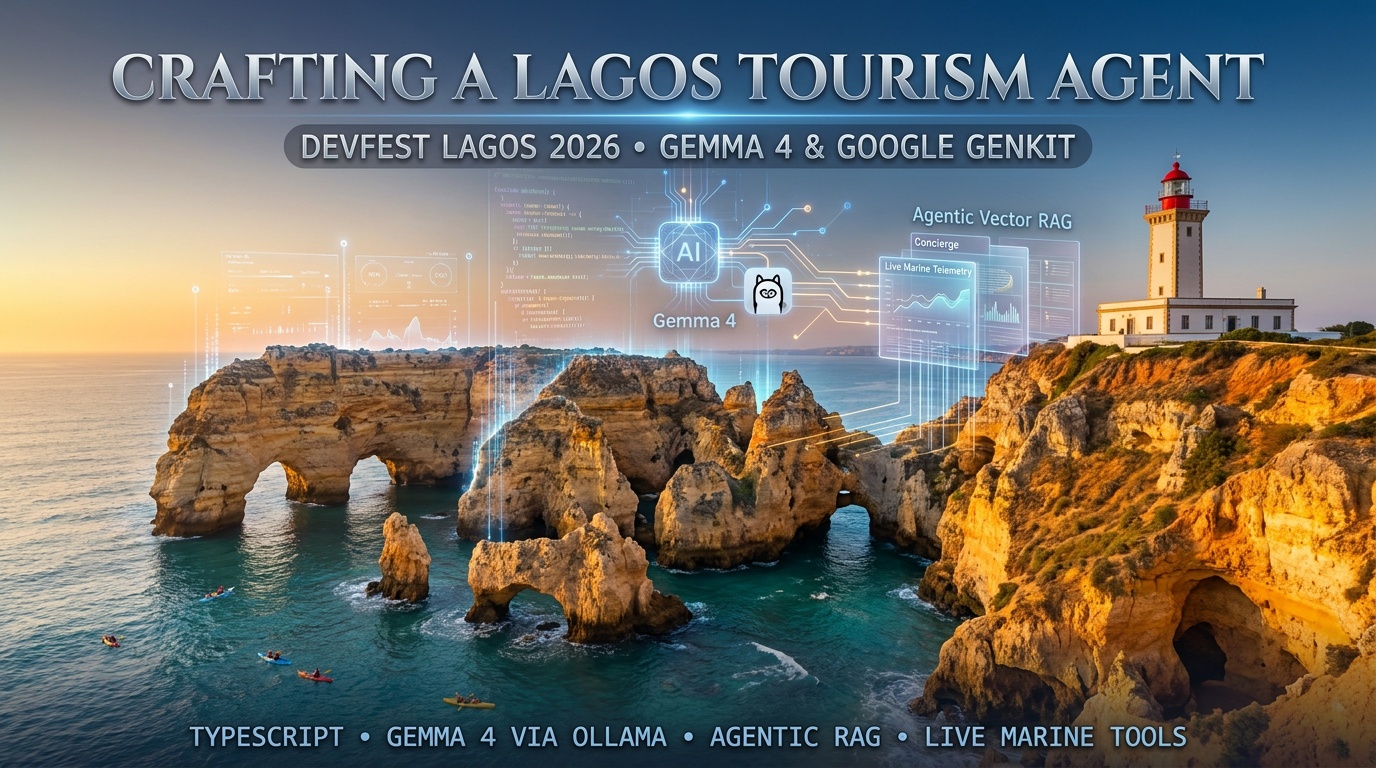
Crafting a Lagos Tourism Agent with Gemma 4 & Genkit
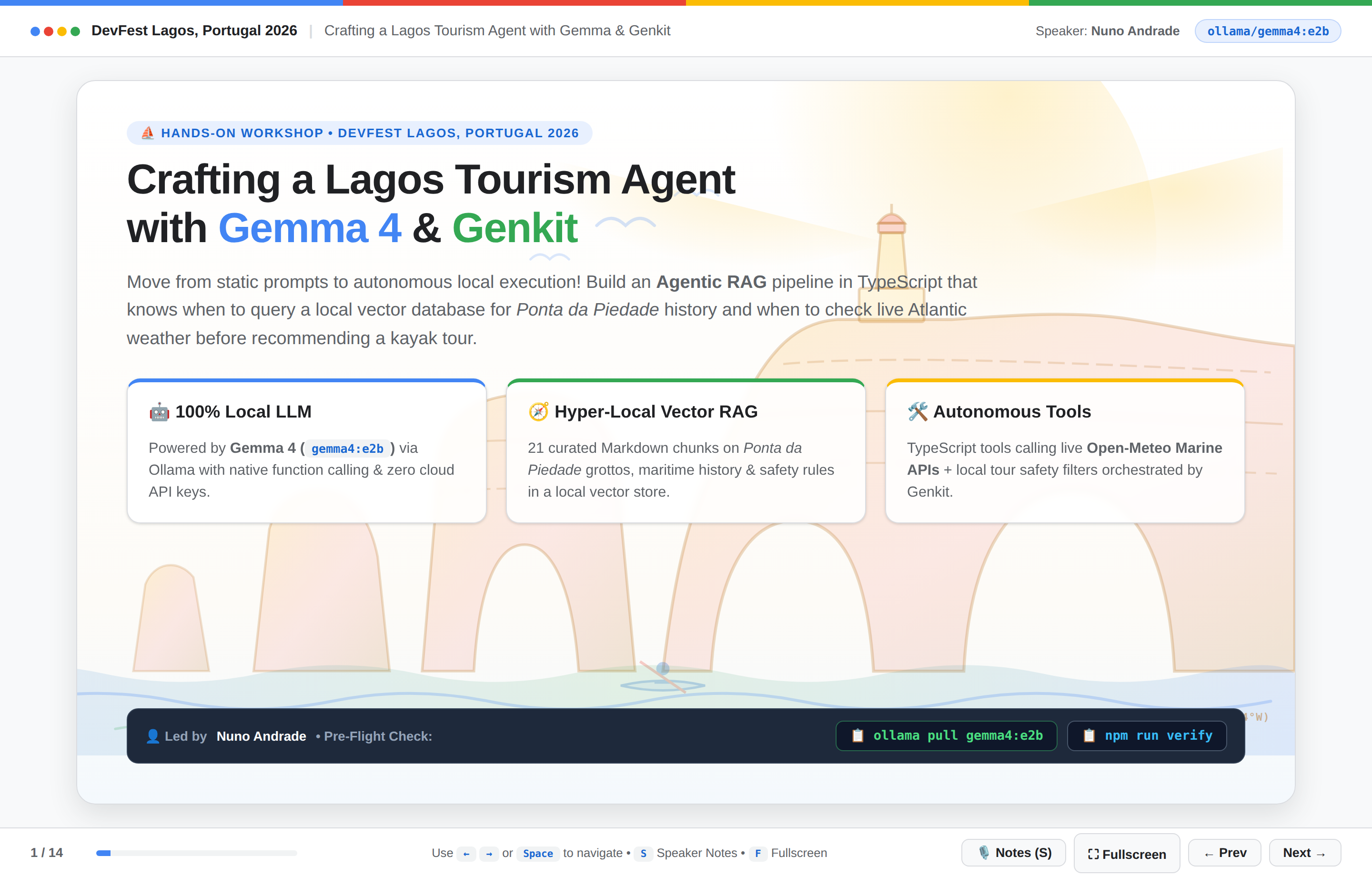
Hands-on technical walkthrough from DevFest Lagos 2026: Build a 100% local, privacy-preserving Agentic RAG tourism concierge in TypeScript using Google's Gemma 4 (gemma4:e2b), Ollama, and the Google Genkit SDK.
Workshop GitHub Repository: https://github.com/nuno-joao-andrade-dev/devfest_lagos_2026/ Interactive Presentation Slides: https://nuno-joao-andrade-dev.github.io/devfest_lagos_2026/slides/ (Source in Repo)
Special Thanks: A special thank you to GDG Lagos and the DevFest Lagos 2026 organizing team for the warm invitation, organization, and support in making this hands-on session in the Algarve possible!
At DevFest Lagos 2026 in the coastal heart of the Algarve, Portugal, we explored one of the most practical shifts in modern AI engineering: moving from cloud-dependent static prompts to 100% local, autonomous Agentic RAG systems in TypeScript.
Using Google’s Gemma 4 (gemma4:e2b) running locally on Ollama and orchestrated by the Google Genkit TypeScript SDK, we built Capitão Gil—an autonomous coastal concierge for Lagos and the Ponta da Piedade sea caves (37.0805° N, 8.6694° W). Over five progressive architectural milestones, our agent evolved from a hallucinating static prompt into a production-ready local system capable of querying a local vector store for 1913 maritime history, checking live Atlantic swell and Nortada wind gusts via Open-Meteo marine APIs, enforcing deterministic sea-cave safety rules, and maintaining multi-turn conversational memory—all with zero cloud API keys and zero per-token billing.
[!NOTE] Key Architectural Goal: Instead of hardcoding a rigid vector lookup before every LLM call (Static RAG), we equip a compact local model (
ollama/gemma4:e2b) with strongly-typed Genkit Tools—turning vector retrieval (searchLagosKnowledge), live marine meteorology (getLagosWeatherAndMarine), and safety-filtered tour discovery (findLagosTours) into autonomous actions that the model plans and chains on demand (Agentic RAG).
Why Static Prompts Fail on the Algarve Coast
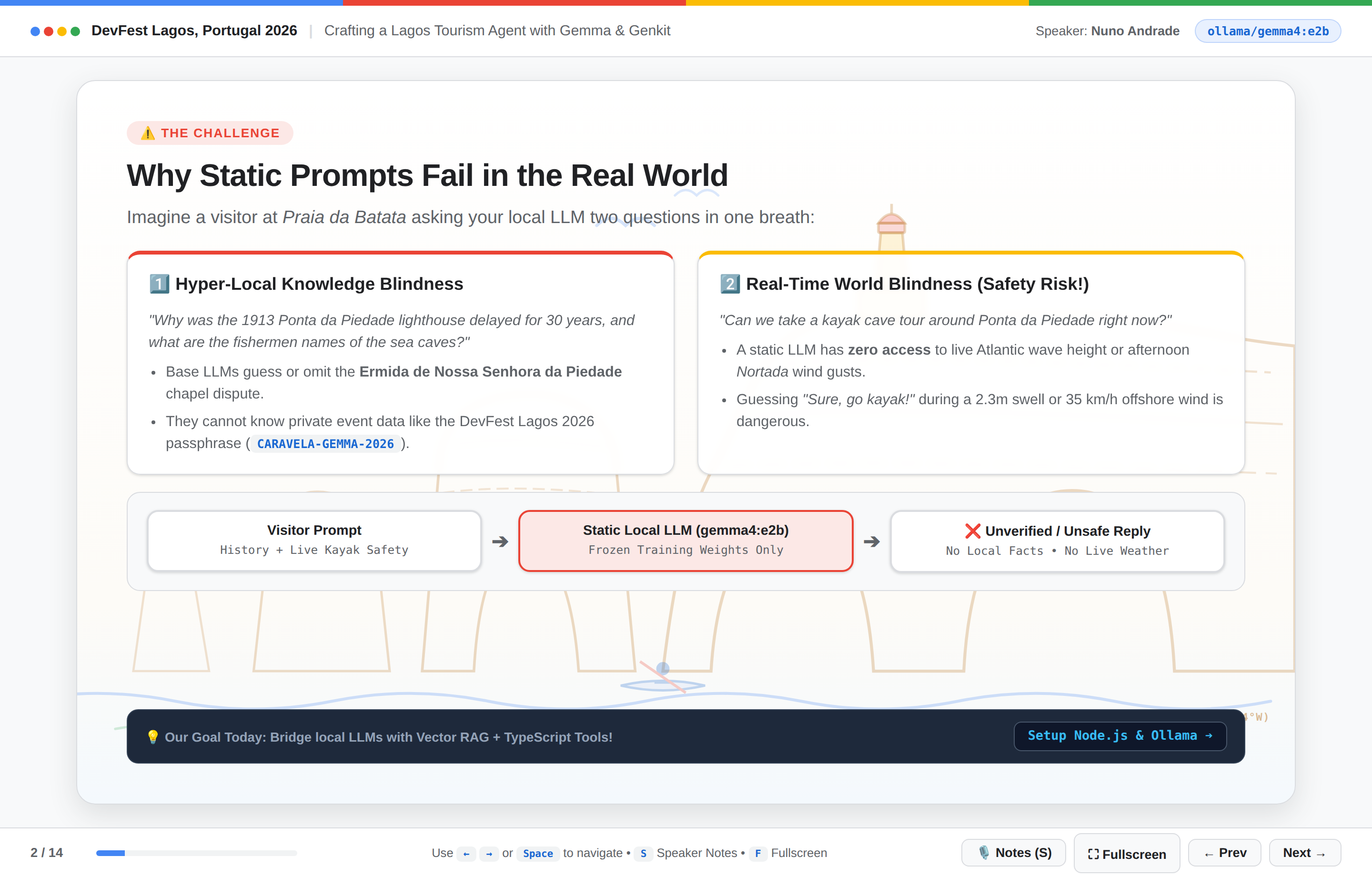
Ask an ungrounded language model “Why was the 1913 Ponta da Piedade lighthouse delayed, and is it safe to take a kayak into the ‘A Cozinha’ grotto right now?” and you immediately hit three fundamental walls:
- Private & Hyper-Local Knowledge Blindness: Pre-trained weights do not know hyper-local archive details (such as the 1910–1913 parish land dispute over the Ermida de Nossa Senhora da Piedade ruins), curated local folklore, or private event facts (like the DevFest Lagos 2026 secret passphrase).
- Real-Time Environmental Blindness: In Lagos, calm morning waters (
12 km/hwind,0.4 mswell) frequently transform after 14:00 into hazardous Nortada offshore gusts (34+ km/h) or2.1 mAtlantic groundswells. A static prompt cannot see current ocean telemetry and will cheerfully recommend paddling into limestone arches that the Capitania do Porto de Lagos has closed. - Rigid Execution: Without tool-calling orchestration, a static prompt cannot decide when to query a document index, when to call a weather sensor API, or how to pivot to a safe land-based cliff boardwalk tour when the sea caves are closed.
The AI Agent Paradigm Shift: Cloud vs. Local-First
Running Gemma 4 (gemma4:e2b) locally via Ollama inside Google Genkit changes the economics, privacy posture, and developer experience of building agentic applications:
| Architectural Dimension | Traditional Cloud-Only Agent | Local-First Edge Agent (Gemma 4 + Genkit + Ollama) |
|---|---|---|
| Inference Runtime | Remote multi-tenant cloud endpoints | 100% On-Device (http://127.0.0.1:11434 via Ollama) |
| Data Privacy & GDPR | User prompts & RAG chunks traverse external networks | Zero data egress; private documents & chat history never leave the machine |
| API Keys & Billing | Requires cloud billing accounts, quotas & per-token fees | $0.00 / token; zero API keys required (OLLAMA_HOST local loopback) |
| Offline Resilience | Fails immediately when conference Wi-Fi drops | Works offline with local vector store (__db_lagos_tourism.json) & fallback weather scenarios |
| Tool & RAG Orchestration | Often coupled to proprietary SDKs | Unified Google Genkit SDK (ai.defineFlow, ai.defineTool, ai.retrieve, Zod schemas) |
| Cloud Portability | Vendor-locked | Swap ollama/gemma4:e2b for Vertex AI / Gemini in one config line (src/config/genkit.ts) |
System Architecture Blueprint
The diagram below illustrates the complete end-to-end runtime architecture we build across the workshop, culminating in Step 05:
flowchart TD
User(["🧑💻 User CLI / Genkit Developer UI<br/>(http://localhost:4000)"])
Flow["⚡ Genkit Flow Orchestrator<br/>(ai.defineFlow + History State)"]
Model["🧠 Local Gemma 4 Reasoning Loop<br/>(ollama/gemma4:e2b • supports: { tools: true })"]
subgraph Tools ["🛠️ Autonomous Genkit Tools (Zod-Validated)"]
direction LR
ToolRAG["🧭 searchLagosKnowledge<br/>(Agentic RAG Tool)"]
ToolWeather["🌊 getLagosWeatherAndMarine<br/>(Live Marine Telemetry Tool)"]
ToolTours["🛶 findLagosTours<br/>(Safety-Aware Tour Matcher)"]
end
subgraph DataSources ["📦 Local & Live Data Sources"]
direction LR
VectorDB[("🗂️ Local Vector Store<br/>__db_lagos_tourism.json<br/>(21 Markdown H2 Chunks)")]
OpenMeteo["🛰️ Open-Meteo Forecast & Marine APIs<br/>(37.0805°N, 8.6694°W)<br/>+ Offline Scenarios"]
TourCatalog[("📋 Lagos Tour Catalog<br/>data/lagos-tours.json<br/>(Max Wind & Swell Thresholds)")]
end
Guardrail["🛡️ Deterministic Capitania Safety Guardrail<br/>(Overrides unsafe sea-cave advice if wind > 20 km/h or wave > 1.2 m)"]
Output(["✅ Structured Response + Telemetry<br/>(latencyMs, toolCallCount, updatedHistory)"])
User -->|"Question + Session History"| Flow
Flow -->|"System Persona (Capitão Gil) + Tools"| Model
Model <-->|"1. Historical / Folklore Query"| ToolRAG
Model <-->|"2. Live Wind & Wave Check"| ToolWeather
Model <-->|"3. Filter Tours by Conditions"| ToolTours
ToolRAG <-->|"Cosine Similarity (768-dim)"| VectorDB
ToolWeather <-->|"HTTP GET / Scenario"| OpenMeteo
ToolTours <-->|"Threshold Evaluation"| TourCatalog
Model -->|"Synthesized Answer"| Guardrail
Guardrail --> Output
Architectural Highlights
- Single Shared Genkit Configuration (
src/config/genkit.ts): Registers thegenkitx-ollamaplugin pointing tohttp://127.0.0.1:11434and explicitly enablessupports: { tools: true }ongemma4:e2bso Genkit unlocks multi-turn function calling. - Resilient Local Vector Store (
@genkit-ai/dev-local-vectorstore): Indexes 21 semantically chunked Markdown sections fromdata/lagos-knowledge/*.mdinto__db_lagos_tourism.jsonusing a deterministic 768-dimensional local embedding pipeline that requires zero cloud API keys. - Live + Deterministic Maritime Telemetry (
src/lib/weather-service.ts): Queries real-time Open-Meteo Forecast and Marine APIs for exact Ponta da Piedade coordinates (37.0805° N, 8.6694° W), while supporting deterministic workshop simulation presets (calm,nortada_windy,atlantic_swell). - Defense-in-Depth Safety Guardrail (
step-05-production-agent/index.ts): Even when an LLM has access to accurate weather tools, production systems never rely solely on probabilistic text generation for physical safety. Step 05 cross-checks the model’s final answer against the sensor’sUNSAFE_CAVES_CLOSEDverdict.
5-Step Progressive Curriculum Roadmap
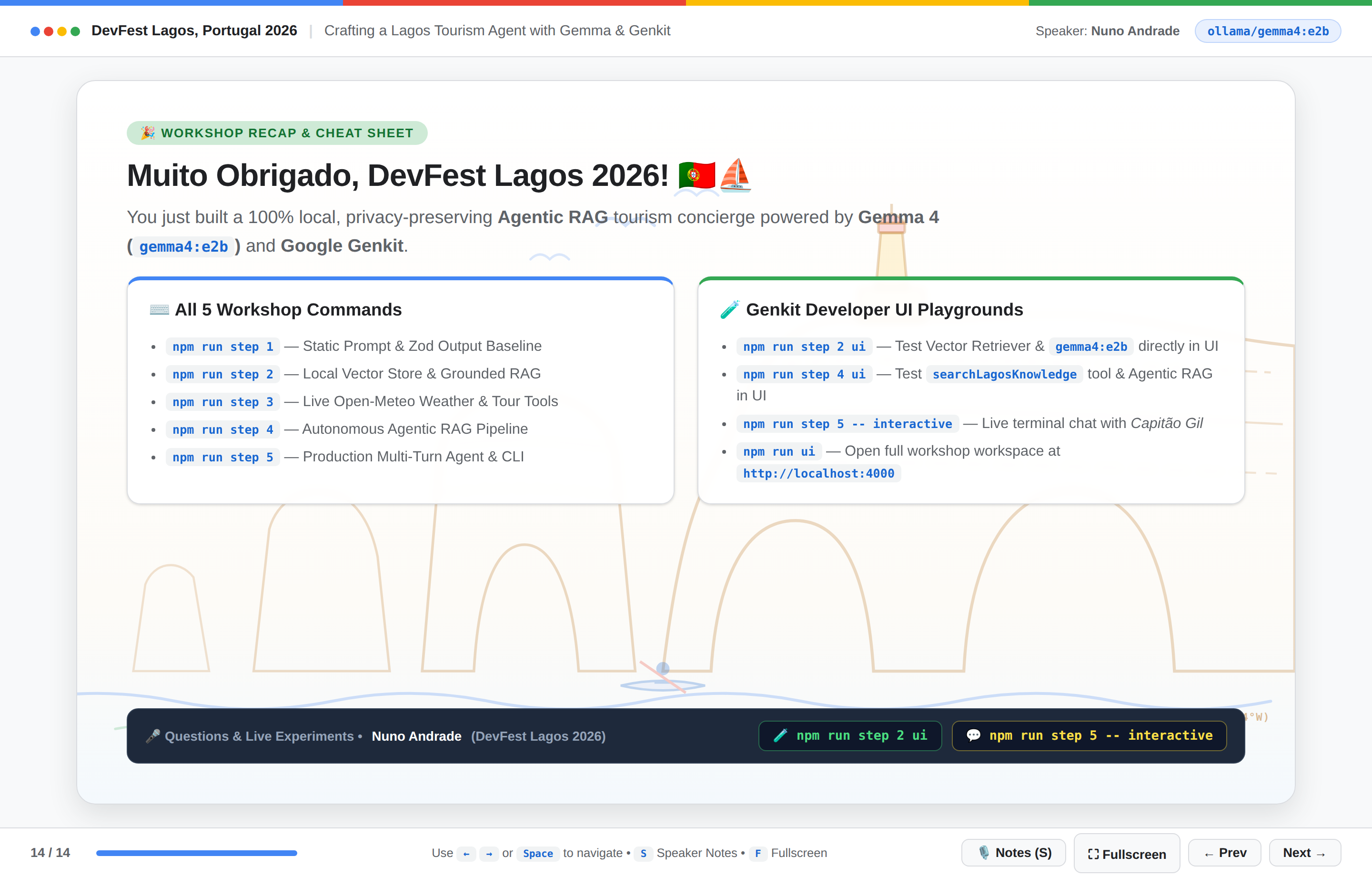
The repository is structured into five self-contained, runnable milestones. Each step builds directly on the previous one and can be executed from the terminal or inspected visually in the Genkit Developer UI (http://localhost:4000).
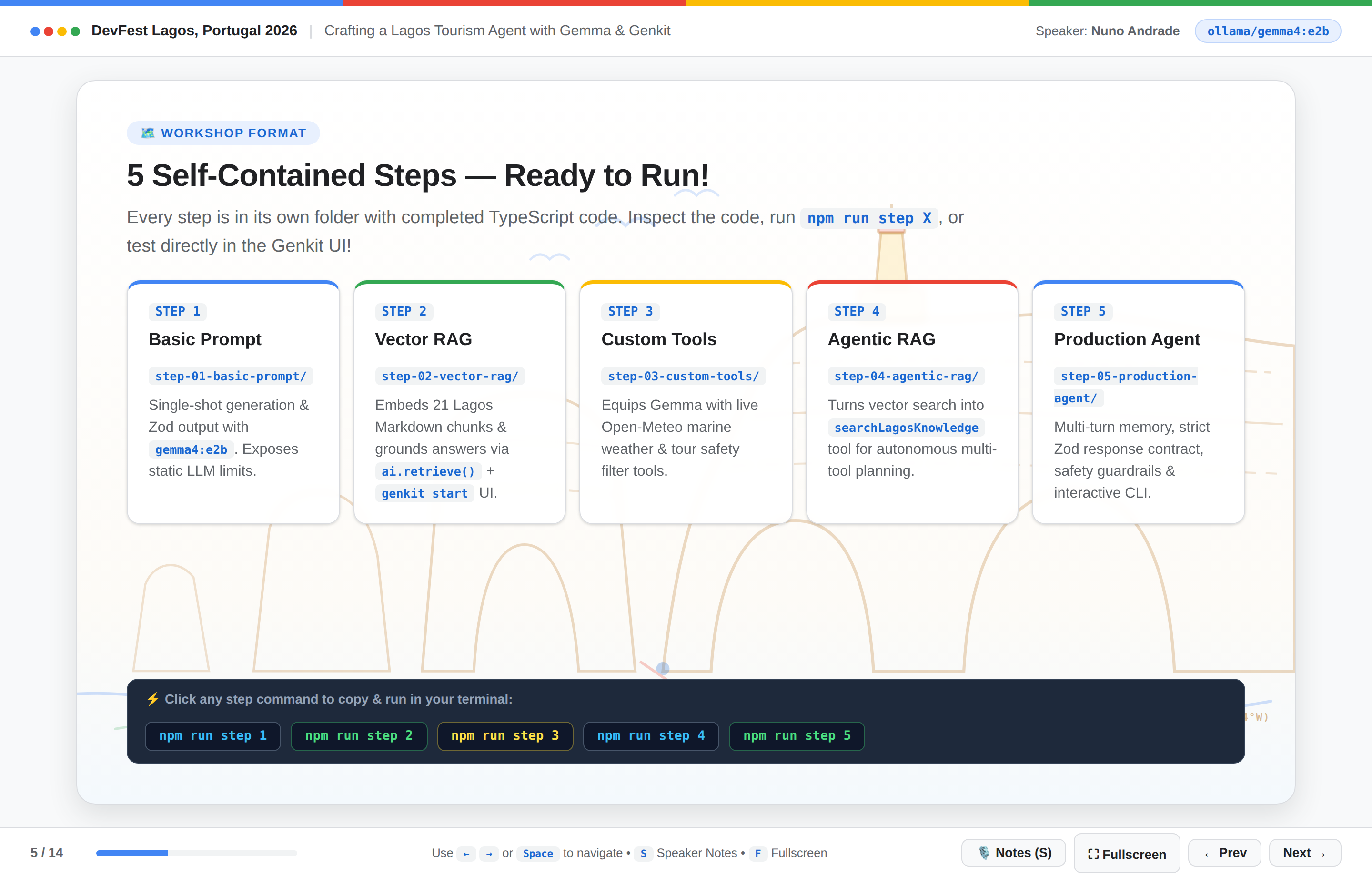
| Step | Directory | Architectural Milestone | Key Genkit Primitives | Terminal & UI Commands |
|---|---|---|---|---|
| Step 01 | step-01-basic-prompt/ | Static Prompt Baseline & Type-Safe Schemas | ai.defineFlow, ai.generate, Zod output.schema | npm run step 1 |
| Step 02 | step-02-vector-rag/ | Local Vector Store Indexing & Static RAG | ai.index, ai.retrieve, Document.fromText | npm run step 2npm run step 2 ui |
| Step 03 | step-03-custom-tools/ | Live Open-Meteo Weather & Tour Filtering Tools | ai.defineTool, multi-tool tools: [...] array | npm run step 3npm run step 3 -- nortada_windy |
| Step 04 | step-04-agentic-rag/ | Autonomous Agentic RAG (searchLagosKnowledge) | Retriever wrapped inside ai.defineTool | npm run step 4npm run step 4 ui |
| Step 05 | step-05-production-agent/ | Multi-Turn Memory, Guardrails & Telemetry | Session history, safety guardrail, interactive CLI | npm run step 5npm run step 5 -- interactive |
Quick-Start Commands
1
2
3
4
5
6
7
8
9
10
# 1. Clone the workshop repository and install dependencies
git clone https://github.com/nuno-joao-andrade-dev/devfest_lagos_2026.git
cd devfest_lagos_2026
npm install

# 2. Pull the local Gemma 4 model via Ollama
ollama pull gemma4:e2b

# 3. Run the automated pre-flight verification suite
npm run verify
Prerequisites & Foundation: Node.js, Ollama & src/config/genkit.ts
Before running Step 01, we configure two local building blocks: Node.js v20+ LTS (with TypeScript executed directly via tsx) and Ollama serving gemma4:e2b on 127.0.0.1:11434.
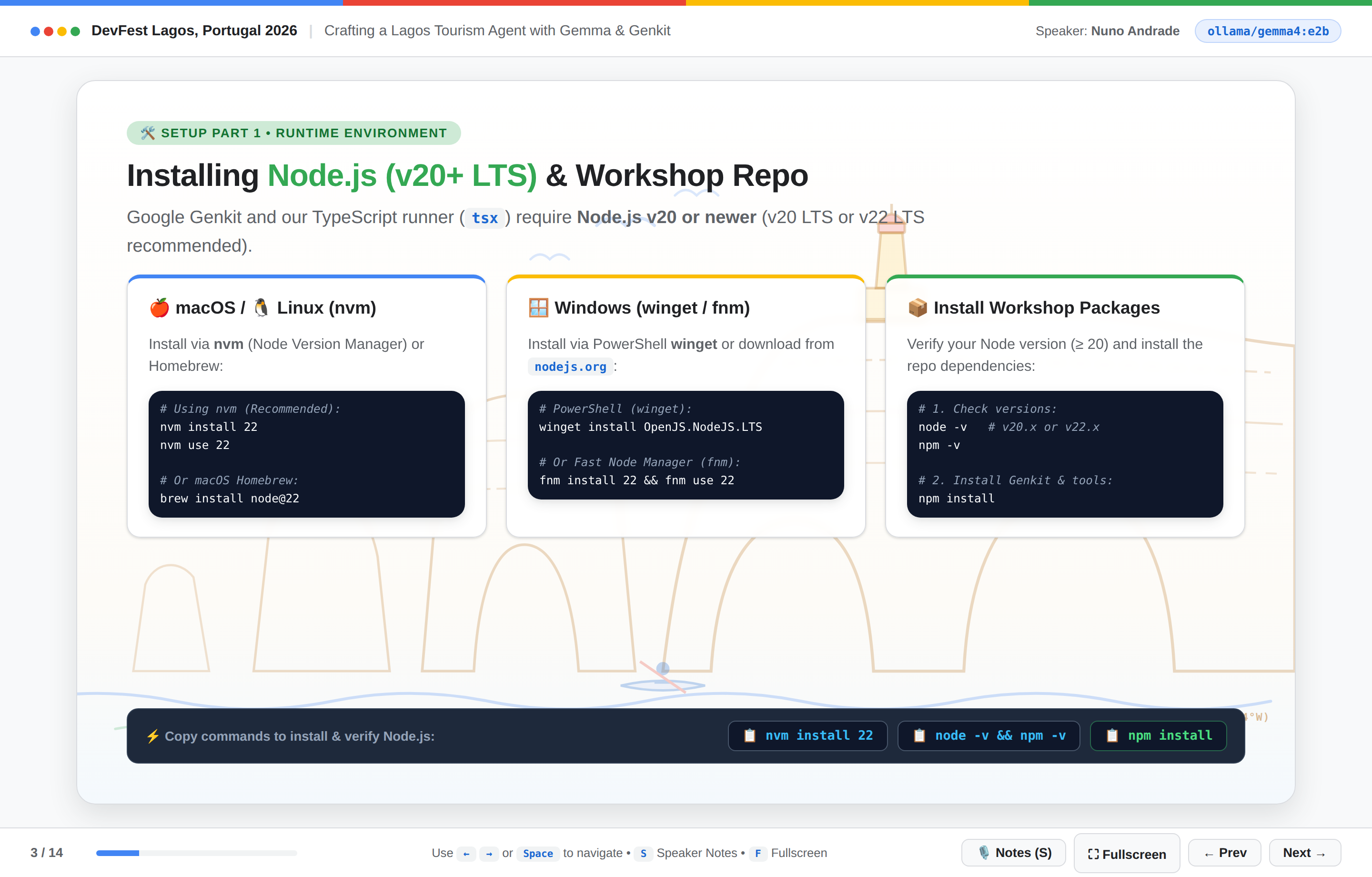
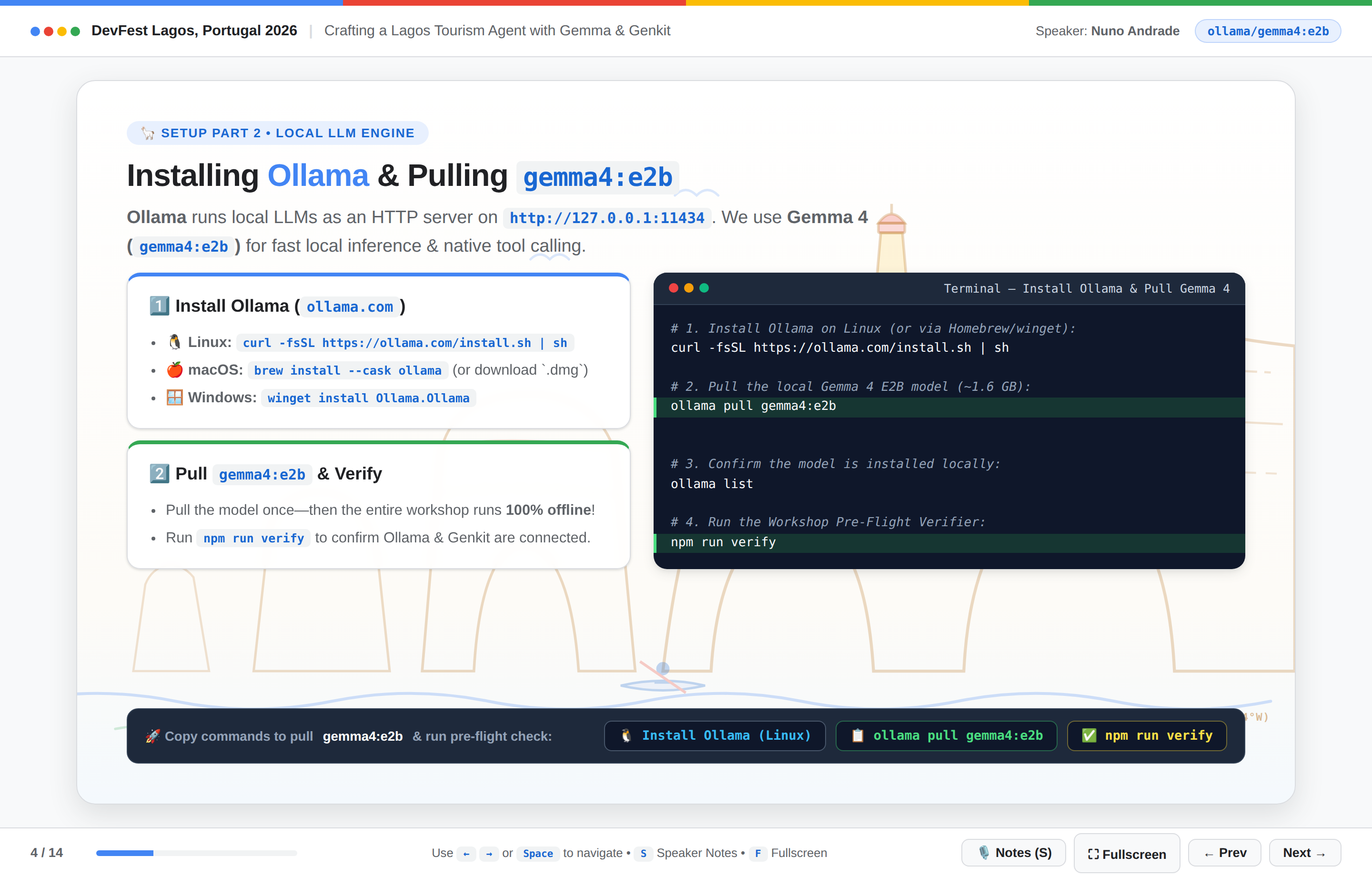
Configuring Genkit + Local gemma4:e2b (src/config/genkit.ts)
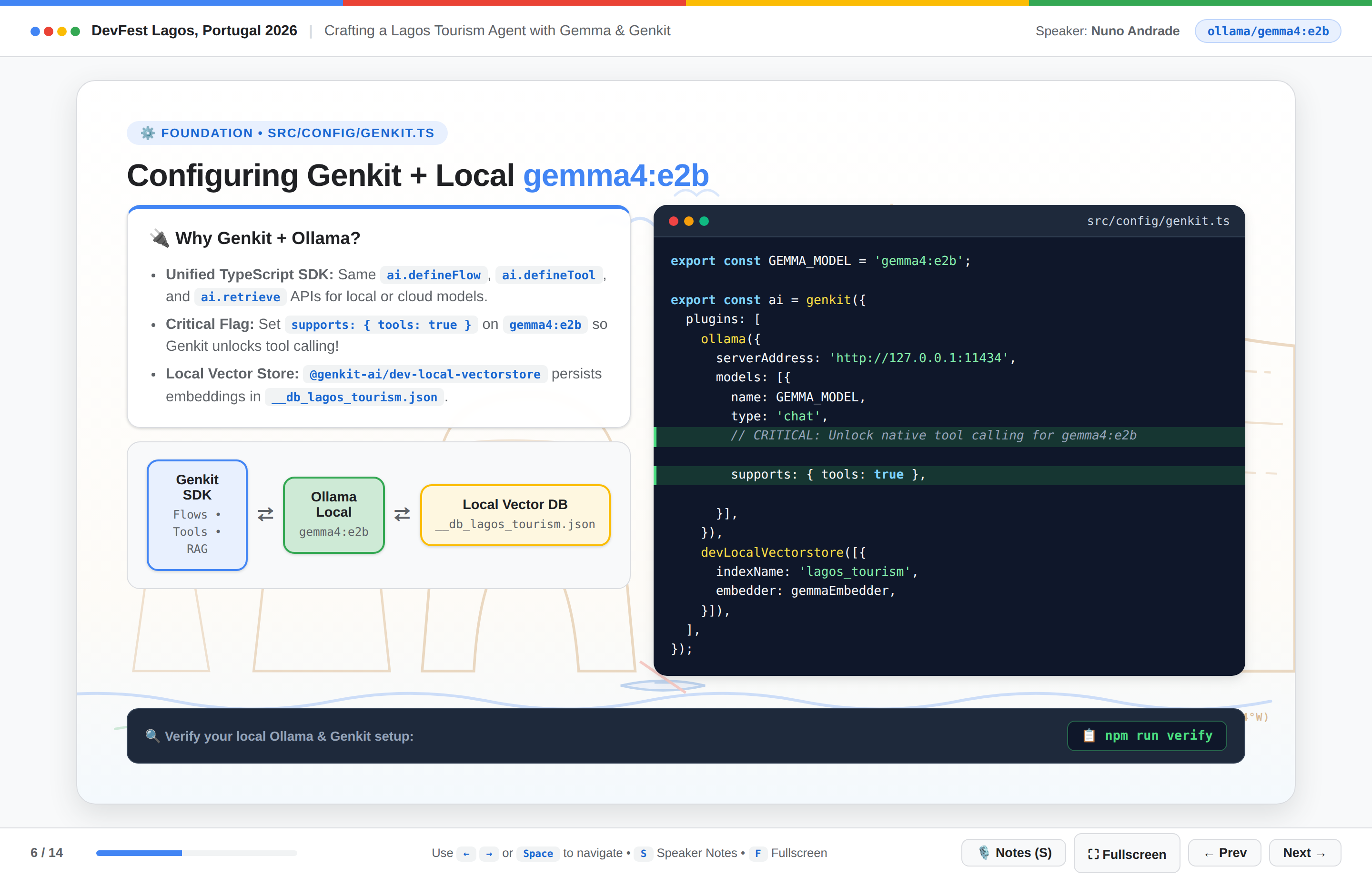
All five workshop steps import their shared Genkit instance ai from src/config/genkit.ts. Two engineering details in this file are essential for reliable local agent execution:
supports: { tools: true }ongemma4:e2b: By default, many local model definitions ingenkitx-ollamado not advertise tool-calling capability to Genkit’s runtime validator. Explicitly passingsupports: { tools: true }unlocksai.defineTool()orchestration in Steps 03–05.- Zero-Dependency Local 768-Dim Embedder (
lagosLocalEmbedder): To ensure@genkit-ai/dev-local-vectorstoreworks out-of-the-box with onlyollama pull gemma4:e2b(and zero external cloud embedding keys or extra model downloads),src/config/genkit.tsdefines a deterministic 768-dimensional character/word n-gram feature-hashing embedder (computeLocal768Embedding) with L2 normalization.
1
2
3
4
5
6
7
8
9
10
11
12
13
14
15
16
17
18
19
20
21
22
23
24
25
26
27
28
29
30
31
32
33
34
35
36
37
38
39
40
41
42
// src/config/genkit.ts
import { genkit, z } from 'genkit';
import { ollama } from 'genkitx-ollama';
import {
  devLocalVectorstore,
  devLocalIndexerRef,
  devLocalRetrieverRef,
} from '@genkit-ai/dev-local-vectorstore';

export const OLLAMA_SERVER_ADDRESS =
  process.env.OLLAMA_HOST || 'http://127.0.0.1:11434';

export const GEMMA_MODEL_NAME = process.env.GEMMA_MODEL || 'gemma4:e2b';
export const GEMMA_MODEL = `ollama/${GEMMA_MODEL_NAME}`;
export const LAGOS_VECTOR_INDEX_NAME = 'lagos_tourism';

export const ai = genkit({
  plugins: [
    ollama({
      serverAddress: OLLAMA_SERVER_ADDRESS,
      models: [
        {
          name: GEMMA_MODEL_NAME,
          type: 'chat',
          // CRITICAL: Explicitly unlock native tool/function calling for gemma4:e2b
          supports: {
            tools: true,
          },
        },
      ],
    }),
    devLocalVectorstore([
      {
        indexName: LAGOS_VECTOR_INDEX_NAME,
        embedder: 'lagosLocalEmbedder',
      },
    ]),
  ],
});

export const lagosIndexer = devLocalIndexerRef(LAGOS_VECTOR_INDEX_NAME);
export const lagosRetriever = devLocalRetrieverRef(LAGOS_VECTOR_INDEX_NAME);
Step 01: Static Prompts & Structured Zod Output
In Step 01 (step-01-basic-prompt/index.ts), we establish our baseline by wrapping a local ollama/gemma4:e2b call inside a strongly-typed Genkit Flow (ai.defineFlow) and enforcing a structured JSON response via a Zod schema (BasicLagosOutputSchema).
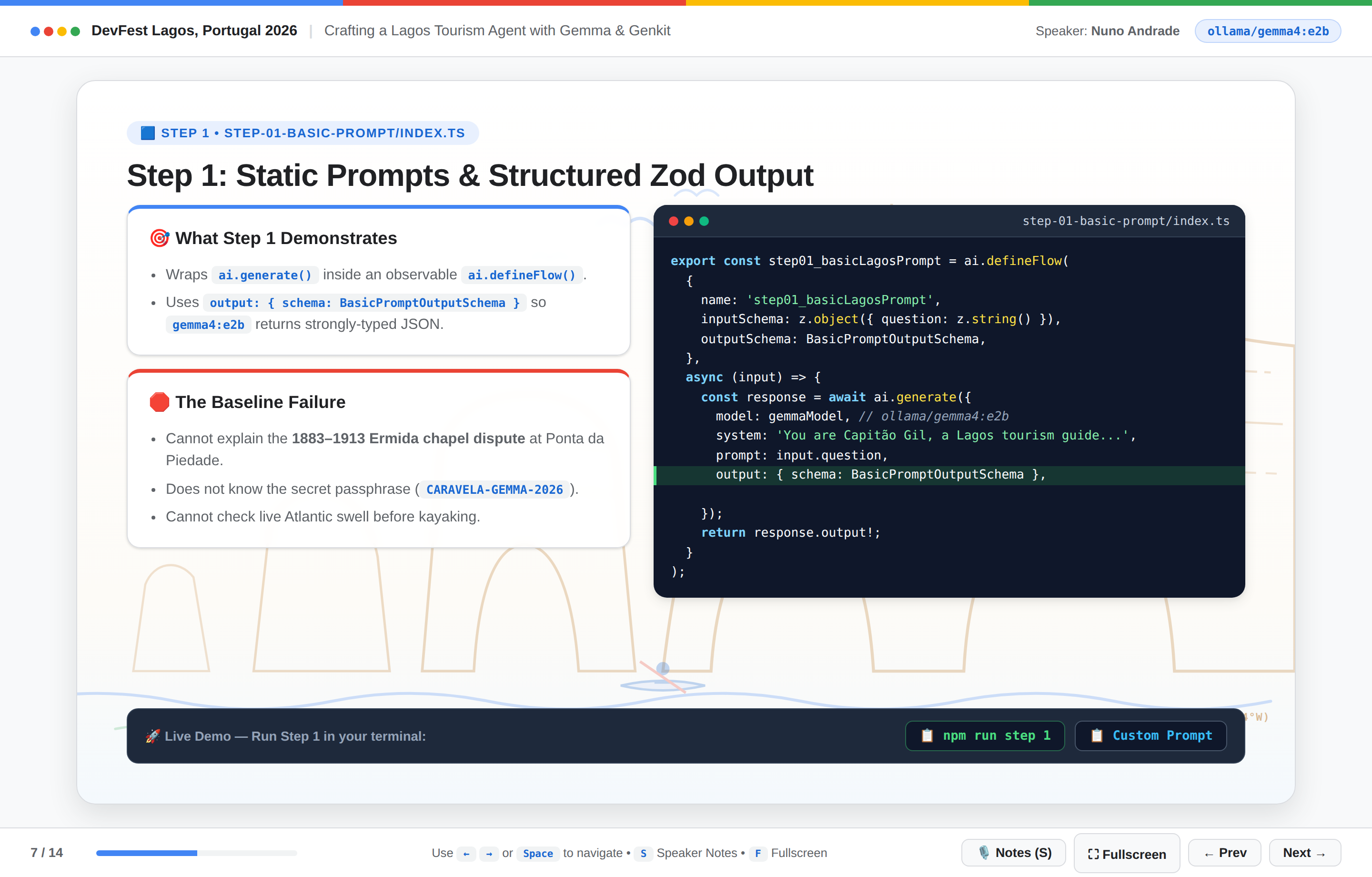
Code Walkthrough (step-01-basic-prompt/index.ts)
1
2
3
4
5
6
7
8
9
10
11
12
13
14
15
16
17
18
19
20
21
22
23
24
25
26
27
28
29
30
31
32
33
34
35
36
37
38
39
40
41
42
43
44
45
46
47
48
49
50
51
52
53
54
55
56
// step-01-basic-prompt/index.ts
import { ai, GEMMA_MODEL, z } from '../src/config/genkit.js';

export const BasicLagosInputSchema = z.object({
  question: z
    .string()
    .default(
      'We are visiting Lagos, Portugal today! What is the history of the 1913 Ponta da Piedade lighthouse, what is the secret DevFest Lagos 2026 passphrase, and is the ocean calm enough right now for a kayak tour into the "A Cozinha" grotto?'
    ),
});

export const BasicLagosOutputSchema = z.object({
  greeting: z.string().describe('A warm Portuguese/Algarve greeting from Lagos'),
  historicalAnswer: z
    .string()
    .describe('Explanation of Ponta da Piedade lighthouse history and sea caves'),
  kayakRecommendation: z
    .string()
    .describe('Recommendation on whether the user should kayak right now'),
  confidenceScore: z
    .number()
    .min(0)
    .max(100)
    .describe('Self-reported confidence score from 0 to 100'),
  knownLimitations: z
    .array(z.string())
    .describe('Things the model cannot verify without external tools or local data'),
});

export const step01BasicLagosFlow = ai.defineFlow(
  {
    name: 'step01_basicLagosConcierge',
    inputSchema: BasicLagosInputSchema,
    outputSchema: BasicLagosOutputSchema,
  },
  async (input) => {
    const response = await ai.generate({
      model: GEMMA_MODEL,
      system:
        'You are Capitão Gil, a friendly tourism concierge in Lagos, Algarve, Portugal. ' +
        'Respond strictly in valid JSON matching the requested schema.',
      prompt: input.question,
      output: {
        schema: BasicLagosOutputSchema,
      },
      config: {
        temperature: 0.3,
      },
    });

    if (response.output) {
      return response.output;
    }
    throw new Error('Model failed to produce structured output.');
  }
);
Running Step 01 & Observing the Baseline Trap
1
npm run step 1
While Zod guarantees a valid JSON structure (greeting, historicalAnswer, kayakRecommendation, confidenceScore, knownLimitations), inspecting the output reveals why static prompts fail in production:
- Historical Hallucination: The model guesses generic lighthouse history instead of citing the 1910–1913 parish church dispute over the Ermida de Nossa Senhora da Piedade ruins or the April 1913 oil-vapor lamp inauguration.
- Missing Private Knowledge: It has no way of knowing the secret DevFest Lagos 2026 passphrase (
FAROL-DE-LAGOS-1913) stored in our local Markdown corpus. - Zero Weather Visibility: It cannot inspect live wind speed or wave height at Ponta da Piedade.
Step 02: Grounding with Local Vector RAG (@genkit-ai/dev-local-vectorstore)
To fix the hallucination problem from Step 01, Step 02 (step-02-vector-rag/index.ts) introduces Retrieval-Augmented Generation (RAG) backed by a local JSON vector database (__db_lagos_tourism.json).
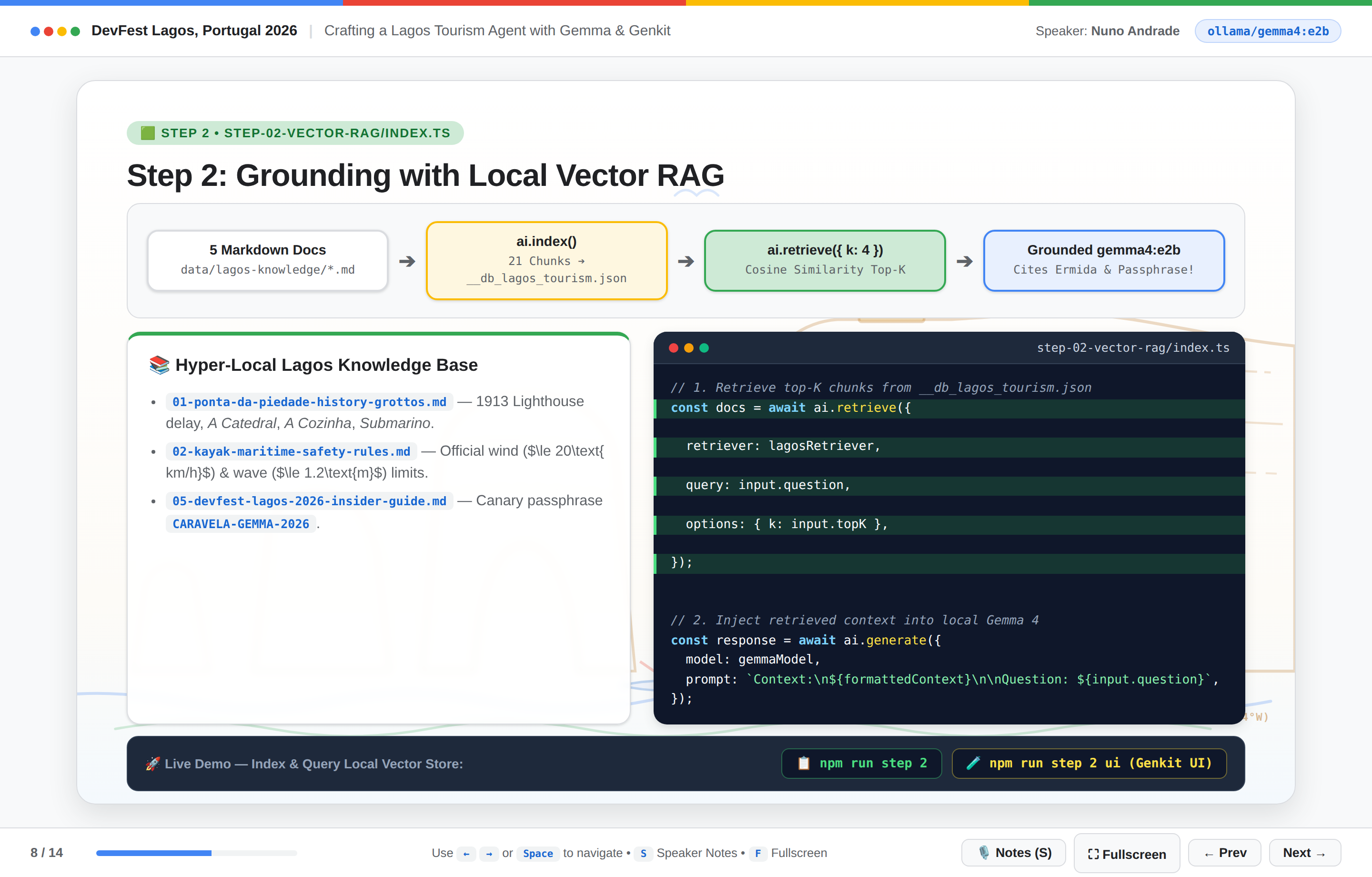
Semantic Markdown Chunking (src/lib/knowledge-loader.ts)
Instead of splitting text at arbitrary character counts (which slices tables and historical paragraphs mid-sentence), src/lib/knowledge-loader.ts splits our three curated Markdown files (ponta-da-piedade-guide.md, lagos-history-gastronomy.md, and kayak-safety-weather-rules.md) along ## (H2) section headers into 21 semantically complete chunks, attaching rich metadata (source, category, section, chunkId) to every Genkit Document:
1
2
3
4
5
6
7
8
9
10
11
12
13
14
15
16
17
18
19
20
21
// src/lib/knowledge-loader.ts (excerpt)
const sections = rawContent
  .split(/\n(?=##\s+)/g)
  .map((s) => s.trim())
  .filter((s) => s.length > 40);

sections.forEach((sectionText, index) => {
  const firstLine = sectionText.split('\n')[0] ?? '';
  const sectionTitle = firstLine.replace(/^#+\s*/, '').trim() || fileName;
  const enrichedText = `[Source: ${title} | Section: ${sectionTitle}]\n${sectionText}`;

  documents.push(
    Document.fromText(enrichedText, {
      source: fileName,
      title,
      category,
      section: sectionTitle,
      chunkId: `${fileName}#chunk-${index + 1}`,
    })
  );
});
Indexing & Retrieving in step-02-vector-rag/index.ts
1
2
3
4
5
6
7
8
9
10
11
12
13
14
15
16
17
18
19
20
21
22
23
24
25
26
27
28
29
30
31
32
33
34
35
36
37
38
39
40
41
42
43
44
45
46
47
48
49
50
51
52
53
54
55
56
57
// step-02-vector-rag/index.ts (excerpt)
export async function ensureLagosKnowledgeIndexed(forceReindex = false): Promise<number> {
  if (!forceReindex && isVectorStorePopulated()) {
    const docs = loadLagosKnowledgeDocuments();
    return docs.length;
  }

  const documents = loadLagosKnowledgeDocuments();
  await ai.index({
    indexer: lagosIndexer,
    documents,
  });
  return documents.length;
}

export const step02VectorRagFlow = ai.defineFlow(
  {
    name: 'step02_ragLagosHistory',
    inputSchema: RagQueryInputSchema,
    outputSchema: RagQueryOutputSchema,
  },
  async (input) => {
    await ensureLagosKnowledgeIndexed(input.forceReindex);

    // 1. Retrieve top-K semantically similar chunks from __db_lagos_tourism.json
    const retrievedDocs = await ai.retrieve({
      retriever: lagosRetriever,
      query: input.question,
      options: { k: input.topK },
    });

    const formattedContext = retrievedDocs
      .map((doc, idx) => `--- CHUNK #${idx + 1} (${doc.metadata?.chunkId}) ---\n${doc.text}`)
      .join('\n\n');

    // 2. Ground local Gemma 4 strictly in the retrieved context
    const response = await ai.generate({
      model: GEMMA_MODEL,
      prompt:
        `You are Capitão Gil, a Lagos historian. Answer using ONLY the retrieved context.\n\n` +
        `RETRIEVED KNOWLEDGE CHUNKS:\n${formattedContext}\n\n` +
        `TOURIST QUESTION: ${input.question}`,
      config: { temperature: 0.2 },
    });

    return {
      question: input.question,
      answer: response.text.trim(),
      retrievedChunks: retrievedDocs.map((doc) => ({
        chunkId: String(doc.metadata?.chunkId ?? 'unknown'),
        section: String(doc.metadata?.section ?? 'General'),
        source: String(doc.metadata?.source ?? 'lagos-knowledge'),
        preview: doc.text.slice(0, 160).replace(/\s+/g, ' ') + '...',
      })),
    };
  }
);
Interactive Checkpoint: Testing RAG & Models in the Genkit Developer UI
One of Genkit’s best developer experience features is the ability to test Models, Retrievers, and Flows in isolation inside the Genkit Developer UI (http://localhost:4000). Step 02 includes a dedicated UI entrypoint (step-02-vector-rag/genkit-ui.ts) that pre-indexes the 21 Lagos chunks on startup:
1
2
npm run step 2 ui
# Opens Genkit Developer UI at http://localhost:4000
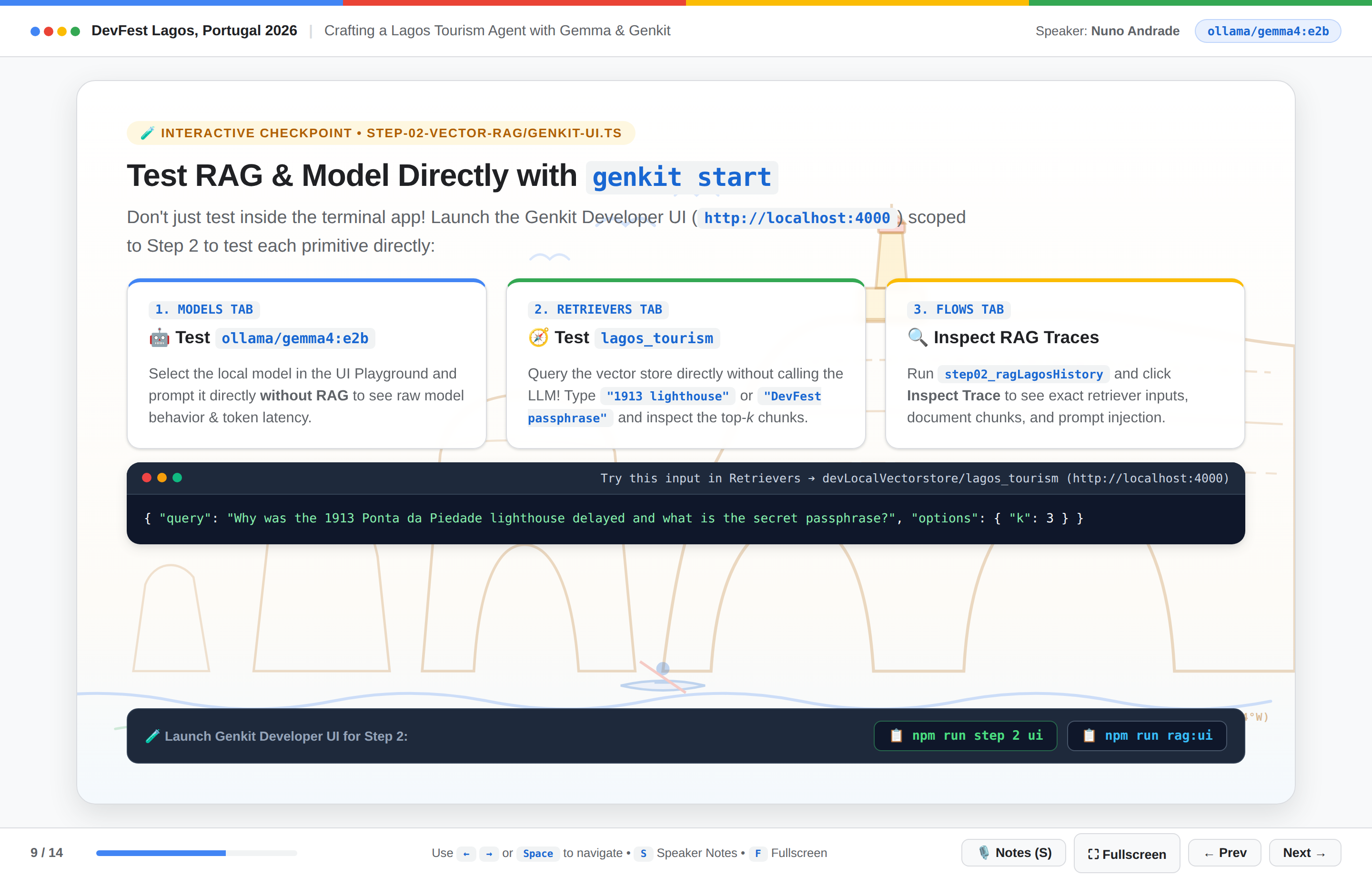
[!TIP] Try this in the Genkit Developer UI (
http://localhost:4000):
- Models Tab (
ollama/gemma4:e2b): Prompt the raw local model without RAG to observe ungrounded output and baseline token latency.- Retrievers Tab (
devLocalVectorstore/lagos_tourism): Test vector similarity directly without invoking the LLM using{ "query": "1913 lighthouse delay and DevFest passphrase", "options": { "k": 3 } }.- Flows Tab (
step02_ragLagosHistory): Run the full RAG flow and click Inspect Trace to see the exact retrieved chunks injected into the prompt.
Step 03: Giving Gemma Hands with Custom TypeScript Tools
Step 02 solved historical grounding—our agent now accurately cites the 1910–1913 parish demolition dispute, the 51-meter limestone cliff, the FAROL-DE-LAGOS-1913 passphrase, and named grottos like A Catedral, A Cozinha, and A Gruta dos Amores.
However, a static vector store still cannot tell a tourist whether the Atlantic Ocean is safe right now. In Step 03 (step-03-custom-tools/index.ts), we give gemma4:e2b hands to interact with the outside world using ai.defineTool().
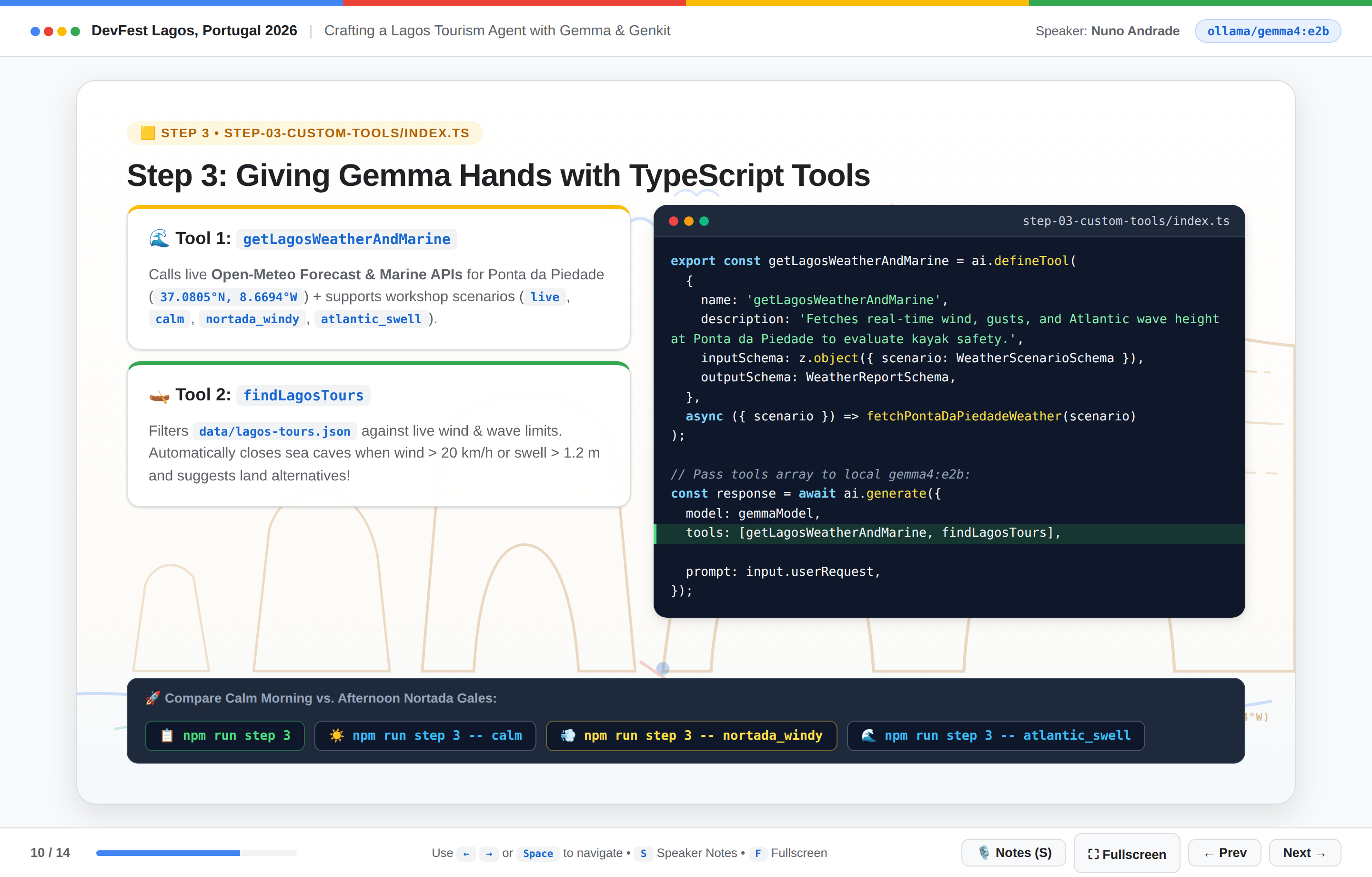
Autonomous Tool-Calling Sequence
sequenceDiagram
autonumber
actor User as 🧑💻 Tourist
participant Flow as ⚡ step03_toolsLagosConcierge
participant Gemma as 🧠 ollama/gemma4:e2b
participant Weather as 🌊 getLagosWeatherAndMarine
participant Tours as 🛶 findLagosTours
User->>Flow: "Can we take a budget kayak tour into Ponta da Piedade grottos right now?"
Flow->>Gemma: Prompt + Tool Schemas (getLagosWeatherAndMarine, findLagosTours)
Note over Gemma: Reasons that sea safety must be<br/>checked before recommending a kayak tour
Gemma->>Weather: Call getLagosWeatherAndMarine({ scenario: "nortada_windy" })
Weather-->>Gemma: { windSpeedKmh: 34.5, windGustsKmh: 48.2, waveHeightM: 1.4, kayakSafetyStatus: "UNSAFE_CAVES_CLOSED" }
Note over Gemma: Sees UNSAFE_CAVES_CLOSED!<br/>Queries tour catalog with current wind & wave
Gemma->>Tours: Call findLagosTours({ currentWindSpeedKmh: 34.5, currentWaveHeightM: 1.4, maxBudgetEur: 50 })
Tours-->>Gemma: Returns safe land alternatives (Cliff Top Walk & Historical Walk) + blocked kayak tours
Gemma-->>Flow: Final safety-aware recommendation pivoting to the Cliff Top Walk
Flow-->>User: Structured response + tool trace
Live Marine Telemetry & Capitania Safety Thresholds (src/lib/weather-service.ts)
In src/lib/weather-service.ts, fetchPontaDaPiedadeWeather() queries the live Open-Meteo Weather Forecast API (wind_speed_10m, wind_gusts_10m, wind_direction_10m) and Open-Meteo Marine API (wave_height, wave_period) for exact Ponta da Piedade coordinates (37.0805° N, 8.6694° W), and evaluates safety against the Capitania do Porto de Lagos thresholds:
SAFE_CALM: Wind $\le 20\text{ km/h}$, gusts $\le 30\text{ km/h}$, wave height $\le 1.0\text{ m}$ — all sea caves open for kayaking and SUP.CAUTION_EXPERIENCED_ONLY: Wind $20\text{–}28\text{ km/h}$ or waves $1.0\text{–}1.2\text{ m}$ — inner arches restricted; larger catamaran cruises only.UNSAFE_CAVES_CLOSED: Wind $> 28\text{ km/h}$, gusts $> 38\text{ km/h}$, or Atlantic swell $> 1.2\text{ m}$ — all sea-cave kayak tours suspended; pivot immediately to land-based cliff boardwalk or historical tours.
Defining Tools in step-03-custom-tools/index.ts
1
2
3
4
5
6
7
8
9
10
11
12
13
14
15
16
17
18
19
20
21
22
23
24
25
26
27
28
29
30
31
32
33
34
35
36
37
// step-03-custom-tools/index.ts (excerpt)
export const getLagosWeatherAndMarine = ai.defineTool(
  {
    name: 'getLagosWeatherAndMarine',
    description:
      'Fetches current wind speed (km/h), wind gusts, wind direction, Atlantic wave height (m), and official kayak safety status for Ponta da Piedade in Lagos, Portugal. ALWAYS call this tool before recommending any kayak, boat, or water activity.',
    inputSchema: z.object({
      scenario: WeatherScenarioSchema.default('live'),
    }),
    outputSchema: WeatherReportSchema,
  },
  async (input) => {
    return await fetchPontaDaPiedadeWeather(input.scenario ?? 'live');
  }
);

export const findLagosTours = ai.defineTool(
  {
    name: 'findLagosTours',
    description:
      'Searches the local Lagos tour catalog (kayak, boat, walking, food, cultural) and evaluates which tours are SAFE to operate given the current wind speed (km/h) and wave height (m).',
    inputSchema: z.object({
      currentWindSpeedKmh: z.number(),
      currentWaveHeightM: z.number(),
      preferredCategory: z.enum(['any', 'kayak', 'boat', 'walking', 'food', 'cultural']).default('any'),
      maxBudgetEur: z.number().optional(),
    }),
  },
  async (input) => {
    return filterToursByWeatherAndPreferences({
      windSpeedKmh: input.currentWindSpeedKmh,
      waveHeightM: input.currentWaveHeightM,
      category: input.preferredCategory === 'any' ? undefined : input.preferredCategory,
      maxPriceEur: input.maxBudgetEur,
    });
  }
);
Testing Calm Morning vs. Afternoon Nortada Gales
1
2
3
4
5
6
7
# Run side-by-side comparison (Calm Morning vs. Afternoon Nortada Gale)
npm run step 3

# Or test specific maritime scenarios:
npm run step 3 -- calm
npm run step 3 -- nortada_windy
npm run step 3 -- atlantic_swell
When run with calm (11.5 km/h wind, 0.45 m wave height), gemma4:e2b recommends the Ponta da Piedade Sea Caves Kayak Expedition (€40). Seconds later, when run with nortada_windy (34.5 km/h offshore Nortada wind with 48.2 km/h gusts and 1.4 m swell), the model sees UNSAFE_CAVES_CLOSED, flags the kayak expedition as suspended, and automatically recommends the Ponta da Piedade Sunset Cliff & Boardwalk Photo Tour (€25) and Old Town Maritime & Cataplana Tasting Walk (€48).
Step 04: Autonomous Agentic RAG (searchLagosKnowledge Tool)
Look closely at the architectural difference between Step 02 and Step 03:
- In Step 02 (Static RAG), we the developers hardcoded
await ai.retrieve(...)at the top of the flow before every single LLM call—even if the user just asked “What is the wind speed right now?” or said “Obrigado!”. - In Step 04 (
step-04-agentic-rag/index.ts), we unify vector retrieval and live API tools into an Agentic RAG pipeline by wrappingai.retrieve()inside a third Genkit Tool:searchLagosKnowledge.
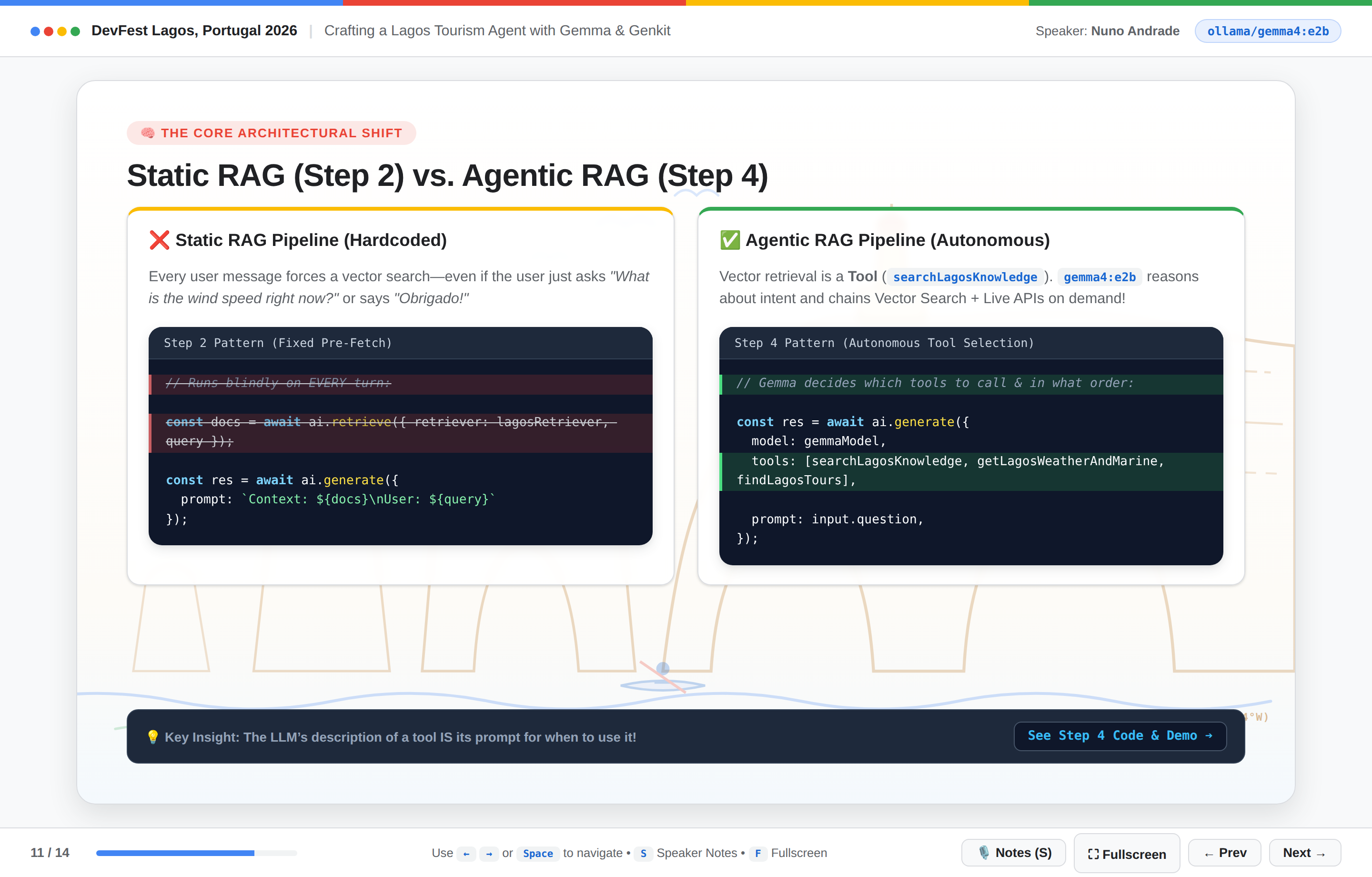
Static RAG vs. Agentic RAG
| Feature | Static RAG (Step 02) | Autonomous Agentic RAG (Step 04) |
|---|---|---|
| Who Triggers Vector Search? | Hardcoded in application code on every request | The LLM (gemma4:e2b) decides if and when to call searchLagosKnowledge |
| Query Formulation | Raw user message is passed verbatim to the embedder | Autonomous Query Rewriting: The LLM distills focused search keywords from long conversational prompts |
| Multi-Source Synthesis | Static documents only | Dynamic Tool Chaining: Combines vector knowledge chunks + live Open-Meteo marine APIs + tour filters in one turn |
| Token Efficiency | Wastes context window on irrelevant chunks during non-knowledge turns | Retrieves vector chunks only when historical, cultural, or grotto knowledge is required |
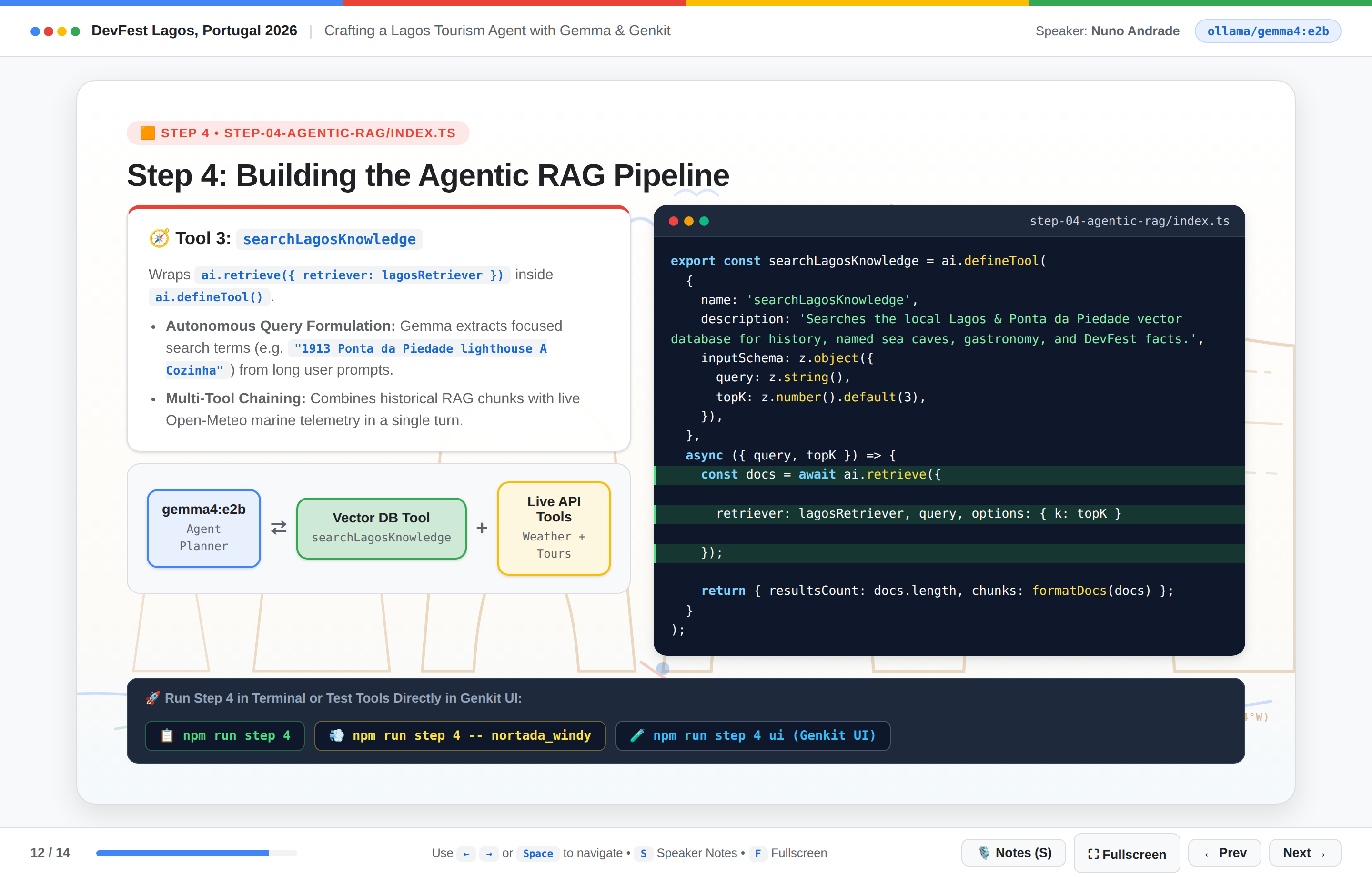
Wrapping ai.retrieve() Inside ai.defineTool() (step-04-agentic-rag/index.ts)
1
2
3
4
5
6
7
8
9
10
11
12
13
14
15
16
17
18
19
20
21
22
23
24
25
26
27
28
29
30
31
32
33
34
35
36
37
38
39
40
41
42
43
44
// step-04-agentic-rag/index.ts (excerpt)
export const searchLagosKnowledge = ai.defineTool(
  {
    name: 'searchLagosKnowledge',
    description:
      'Searches the local Lagos & Ponta da Piedade knowledge base (vector store) for historical facts, the 1913 lighthouse history, named sea caves (A Catedral, A Cozinha, Gruta dos Amores, Submarino), traditional Algarve gastronomy (Cataplana, Dom Rodrigo), and maritime safety rules.',
    inputSchema: z.object({
      query: z
        .string()
        .describe('Focused search keywords about Lagos history, caves, food, or safety rules'),
      topK: z.number().min(1).max(6).default(3),
    }),
    outputSchema: z.object({
      resultsCount: z.number(),
      chunks: z.array(
        z.object({
          chunkId: z.string(),
          section: z.string(),
          source: z.string(),
          content: z.string(),
        })
      ),
    }),
  },
  async (input) => {
    await ensureLagosKnowledgeIndexed(false);

    const docs = await ai.retrieve({
      retriever: lagosRetriever,
      query: input.query,
      options: { k: input.topK ?? 3 },
    });

    return {
      resultsCount: docs.length,
      chunks: docs.map((doc) => ({
        chunkId: String(doc.metadata?.chunkId ?? 'unknown'),
        section: String(doc.metadata?.section ?? 'General'),
        source: String(doc.metadata?.source ?? 'lagos-knowledge'),
        content: doc.text,
      })),
    };
  }
);
Engineering Resilience for Small Local Models (src/lib/tool-execution-helper.ts)
When working with compact edge models (2B–4B parameters) across diverse attendee laptops and Ollama builds, two practical edge cases can surface:
- Certain quantized Ollama model templates omit the
{{ .Tools }}block, causing the model to emit JSON tool calls in plain text rather than nativetool_callspayloads. - Small models occasionally call only one tool when a complex multi-part prompt requires chaining all three (
searchLagosKnowledge+getLagosWeatherAndMarine+findLagosTours).
To make our workshop 100% deterministic across every Ollama version, we include two complementary layers:
Modelfile.gemma4-tools: A ready-to-use Ollama Modelfile (ollama create gemma4-tools -f Modelfile.gemma4-tools) that explicitly wires native tool declarations into the chat template.src/lib/tool-execution-helper.ts(generateWithToolsResilient): Inspects the native Genkit message history fortoolRequest/toolResponseblocks and seamlessly executes a structured fallback tool loop if the local Ollama template did not trigger native tool calls.
1
2
3
4
5
6
# Run Step 04 in the terminal (default live weather or simulated Nortada gale)
npm run step 4
npm run step 4 -- nortada_windy

# Or launch the Genkit Developer UI scoped to Step 04 to test all 3 tools interactively:
npm run step 4 ui
Step 05: Production-Ready Local Agent, Multi-Turn Memory & Guardrails
What separates an impressive conference demo from a production-ready local agent? In Step 05 (step-05-production-agent/index.ts), we upgrade our Agentic RAG pipeline with four production capabilities:
- Multi-Turn Conversational Memory (
history): Passes structured session history (userandmodelturns) across requests so follow-up questions like “What if the wind calms down tomorrow morning and where should we eat afterward?” retain full context without repeating earlier questions. - Deterministic Maritime Safety Guardrail: Cross-checks the LLM’s final natural-language answer against the live marine sensor’s
UNSAFE_CAVES_CLOSEDverdict. Even if a local model hallucinates that kayaking is fine during a34.5 km/hgale, the deterministic guardrail injects a mandatory Capitania Safety Override. - Execution Telemetry: Captures
latencyMs,toolCallCount,toolsInvoked, andsafetyVerdicton every turn. - Interactive Terminal Concierge & Full Genkit UI: Supports both a scripted 2-turn verification demo (
npm run step 5) and a live interactive terminal chat (npm run step 5 -- interactive).
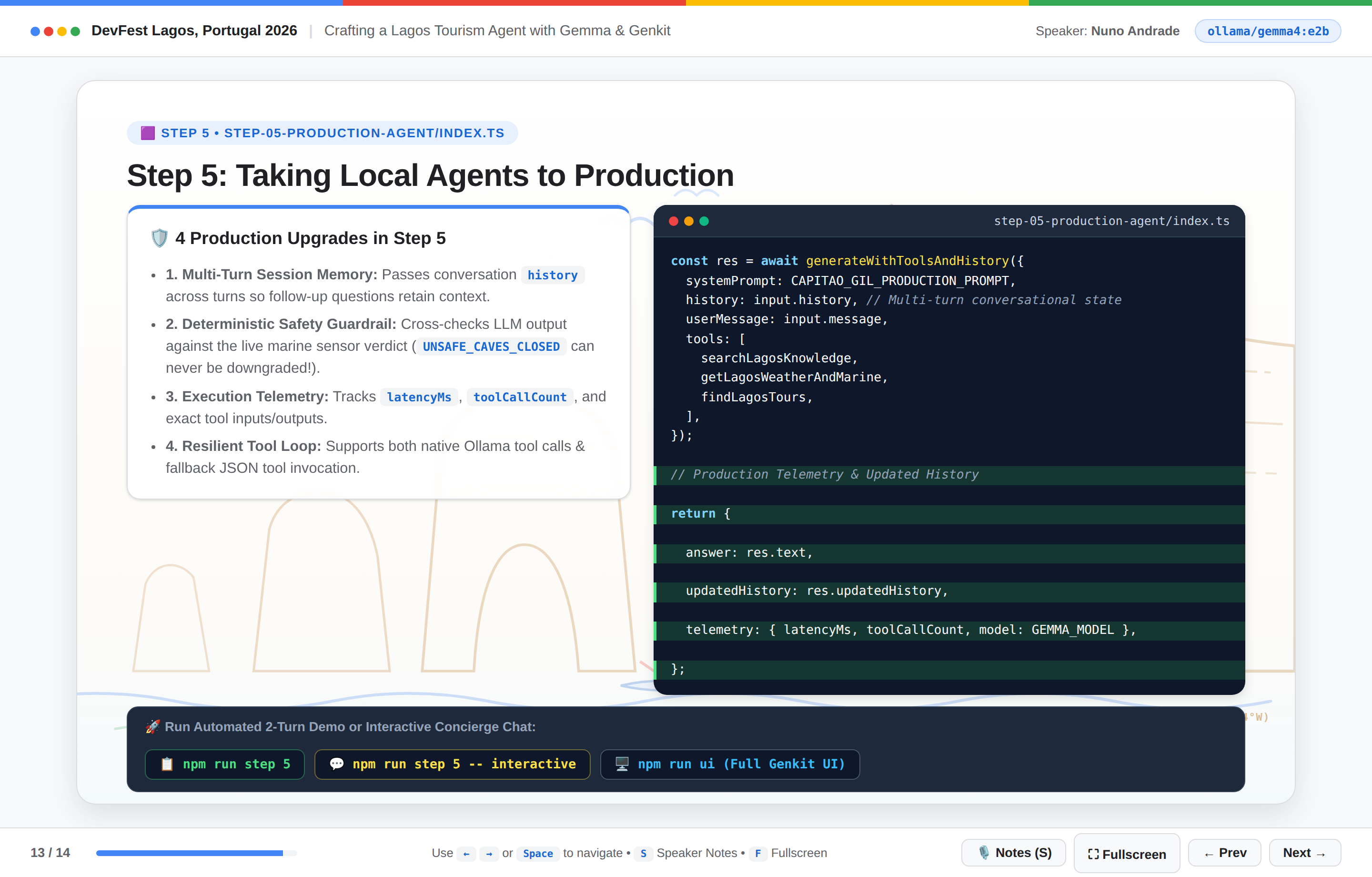
Production Flow & Deterministic Safety Guardrail (step-05-production-agent/index.ts)
1
2
3
4
5
6
7
8
9
10
11
12
13
14
15
16
17
18
19
20
21
22
23
24
25
26
27
28
29
30
31
32
33
34
35
36
37
38
39
40
41
42
43
44
45
46
47
48
49
50
51
52
53
// step-05-production-agent/index.ts (excerpt)
export const step05ProductionConciergeFlow = ai.defineFlow(
  {
    name: 'step05_productionLagosConcierge',
    inputSchema: ProductionAgentInputSchema,
    outputSchema: ProductionAgentOutputSchema,
  },
  async (input) => {
    const startTime = Date.now();
    await ensureLagosKnowledgeIndexed(false);

    const weatherSnapshot = await fetchPontaDaPiedadeWeather(input.weatherScenario);

    const result = await generateWithToolsAndHistory({
      systemPrompt:
        `${CAPITAO_GIL_PRODUCTION_PROMPT}\n` +
        `Note: If calling getLagosWeatherAndMarine, use scenario="${input.weatherScenario}".`,
      history: input.history,
      userMessage: input.message,
      tools: [searchLagosKnowledge, getLagosWeatherAndMarine, findLagosTours],
      temperature: 0.25,
    });

    let finalAnswer = result.text;

    // Production Safety Guardrail: Ensure unsafe sea conditions are NEVER downplayed
    if (
      weatherSnapshot.kayakSafetyStatus === 'UNSAFE_CAVES_CLOSED' &&
      !finalAnswer.toLowerCase().includes('unsafe') &&
      !finalAnswer.toLowerCase().includes('closed') &&
      !finalAnswer.toLowerCase().includes('suspended')
    ) {
      finalAnswer +=
        `\n\n⚠️ [Capitania Safety Guardrail]: Please note that current marine conditions at Ponta da Piedade are ` +
        `UNSAFE_CAVES_CLOSED (${weatherSnapshot.windSpeedKmh} km/h wind, ${weatherSnapshot.waveHeightM} m swell). ` +
        `All sea-cave kayak tours are currently suspended in favor of land-based tours.`;
    }

    const latencyMs = Date.now() - startTime;

    return {
      answer: finalAnswer,
      safetyVerdict: weatherSnapshot.kayakSafetyStatus,
      updatedHistory: result.updatedHistory,
      telemetry: {
        model: GEMMA_MODEL,
        latencyMs,
        toolCallCount: result.toolsCalled.length,
        toolsInvoked: result.toolsCalled.map((t) => t.name),
      },
    };
  }
);
Chatting Live with Capitão Gil
1
2
3
4
5
6
7
8
# Run the automated 2-turn multi-turn memory & safety guardrail showcase
npm run step 5

# Or launch the interactive CLI concierge
npm run step 5 -- interactive

# Or open the full 5-step workshop workspace in the Genkit Developer UI
npm run ui
Inside npm run step 5 -- interactive, you can switch weather conditions on the fly using /scenario calm, /scenario nortada_windy, /scenario atlantic_swell, or /scenario live and watch Capitão Gil dynamically adapt its tool calls and recommendations across turns.
Instructor Troubleshooting & Common Traps
During hands-on workshops with local models, a few predictable environment issues can crop up. Here is the quick-reference diagnostic table we use on stage and in npm run verify:
| Symptom / Error Message | Root Cause | Immediate Resolution |
|---|---|---|
fetch failed or ECONNREFUSED 127.0.0.1:11434 | Ollama daemon is not running locally | Run ollama serve in a background terminal or launch the Ollama desktop app, then re-run npm run verify. |
model 'gemma4:e2b' not found | Model tag has not been pulled yet | Run ollama pull gemma4:e2b (or set GEMMA_MODEL=gemma3:4b in .env if using an already cached tag). |
Model ollama/gemma4:e2b does not support tools | Missing supports: { tools: true } in plugin config | Verify src/config/genkit.ts includes supports: { tools: true } inside the ollama({ models: [...] }) declaration. |
| Model outputs raw JSON tool call text instead of invoking the tool | Local Ollama model tag template omits {{ .Tools }} | Automatic fallback in src/lib/tool-execution-helper.ts handles this transparently; or run ollama create gemma4-tools -f Modelfile.gemma4-tools. |
Retriever returns 0 chunks in Step 02 or Step 04 | Local vector index file __db_lagos_tourism.json was deleted or corrupted | Run npm run step 2 (which calls ensureLagosKnowledgeIndexed()) or pass { "forceReindex": true } in the Genkit UI. |
Conference Wi-Fi blocks outbound calls to api.open-meteo.com | Captive portal or offline network | src/lib/weather-service.ts automatically falls back to deterministic Ponta da Piedade telemetry after a 3.5s timeout, or pass -- calm / -- nortada_windy. |
Key Architectural Takeaways
- Small Local Models Punch Above Their Weight When Grounded: A compact local model like Gemma 4 (
gemma4:e2b) does not need to memorize every historical date in its weights when paired with a fast, semantically chunked local vector store (@genkit-ai/dev-local-vectorstore) and clear tool descriptions. - A Tool’s
descriptionIs Its Routing Prompt: In Agentic RAG (Step 04),gemma4:e2bdecides whether to query the vector store (searchLagosKnowledge), check ocean telemetry (getLagosWeatherAndMarine), or filter tours (findLagosTours) entirely based on the semantic clarity of each tool’sdescriptionand ZodinputSchema. - Wrap Retrievers as Tools for Multi-Source Reasoning: Moving
ai.retrieve()out of hardcoded pre-fetch glue code and intoai.defineTool()transforms a rigid Q&A pipeline into an autonomous agent that can combine historical knowledge with real-time APIs in a single turn. - Never Trust Probabilistic Text Alone for Physical Safety: When building agents that reason about real-world safety thresholds (such as sea-cave closures during Nortada gales), always pair LLM tool calling with a deterministic post-generation guardrail (Step 05).
- Visual Trace Inspection Accelerates Debugging: Running
npm run step 2 ui,npm run step 4 ui, ornpm run ui(genkit startathttp://localhost:4000) lets you inspect every retriever chunk, tool input/output payload, and model latency trace without guessing what happened inside the prompt.
Special Thanks & Resources
A huge Muito Obrigado to GDG Lagos for the warm invitation to speak and run this workshop at DevFest Lagos 2026, and to the organizers, volunteers, and all the developers who joined this hands-on session in the Algarve!
- Workshop Repository & Code: https://github.com/nuno-joao-andrade-dev/devfest_lagos_2026/
- Interactive Presentation Slides: https://nuno-joao-andrade-dev.github.io/devfest_lagos_2026/slides/ (
slides/index.html) - Google Genkit Documentation: genkit.dev
- Google Gemma Models on Ollama: ollama.com/library/gemma4
- Open-Meteo Marine Weather API: open-meteo.com/en/docs/marine-weather-api